
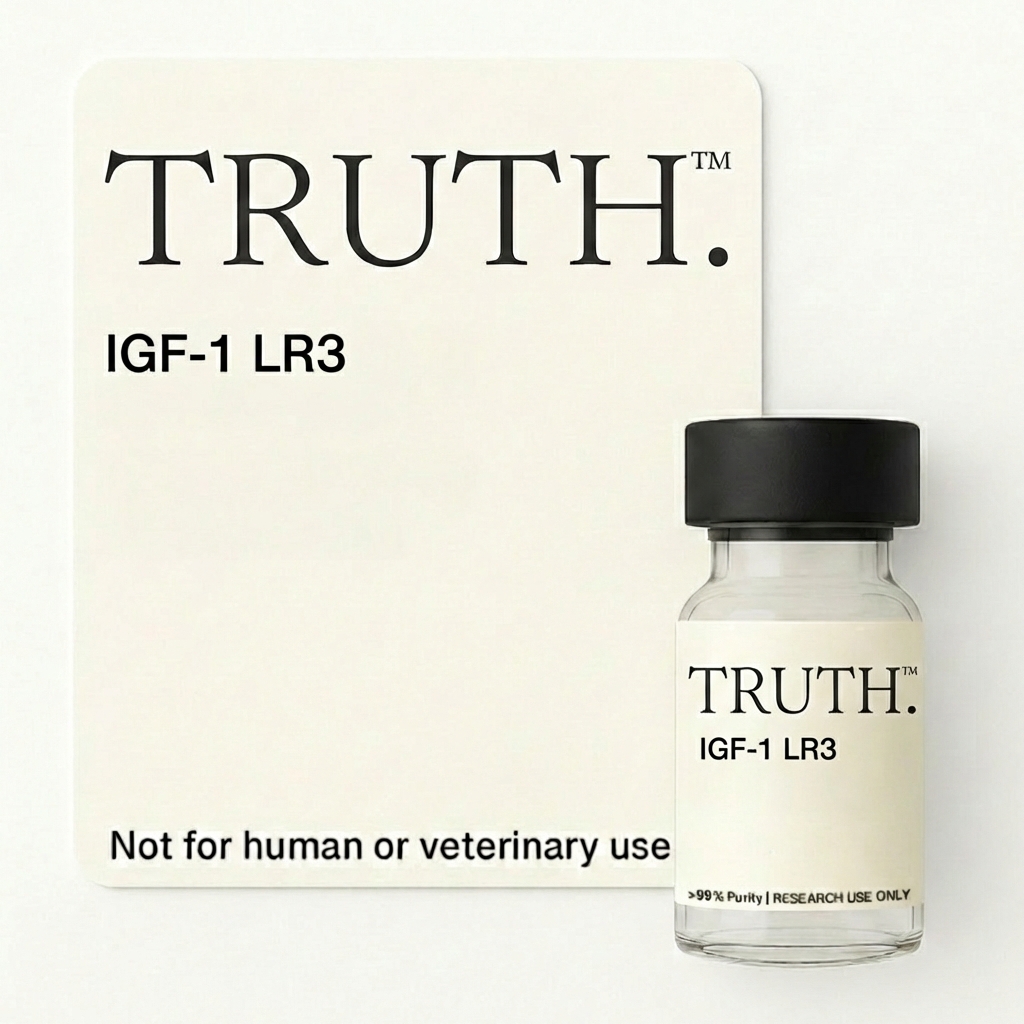
IGF-1 LR3 1mg
Modified Growth Factor for Cellular Growth & Signaling Research
🎁 FREE 3ml Bacteriostatic Water with Every Vial Purchased
Every peptide vial order automatically includes a complimentary 3ml vial of bacteriostatic water at no extra cost.
$175.00
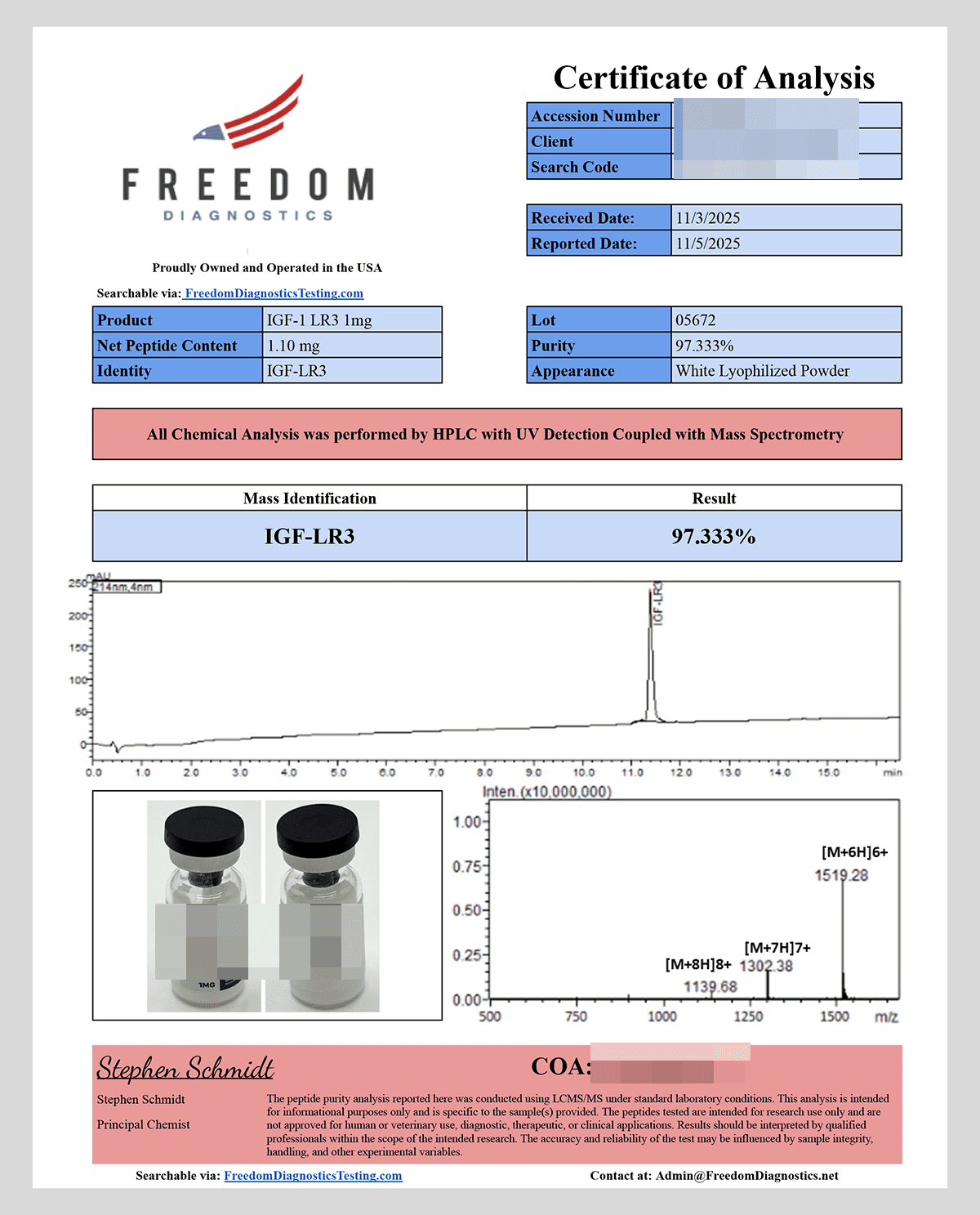
- 99%+ Purity Tested
- Canadian Lab Tested
- Ships from Toronto, Ontario
- Free Bacteriostatic Water with Every Order
Overview
IGF-1 LR3 is a modified analog of insulin-like growth factor-1 (IGF-1), engineered with an extended amino acid sequence that alters binding affinity and signaling duration. In research settings, IGF-1 LR3 is studied for its role in cellular growth signaling, anabolic pathway activation, and metabolic regulation.
This modified structure allows researchers to examine IGF-1 receptor (IGF-1R) signaling dynamics with reduced binding to IGF-binding proteins, making IGF-1 LR3 a valuable model for extended signaling studies.
IGF-1 LR3 is frequently referenced in cell biology, metabolism, recovery, and growth-factor research models due to its enhanced receptor interaction profile.
Mechanism of Action
IGF-1 LR3 exerts its effects by binding to the IGF-1 receptor (IGF-1R) on target cells, initiating intracellular signaling cascades involved in growth and metabolism.
Research indicates IGF-1 LR3 signaling involves:
- Activation of PI3K/Akt signaling pathways
- Stimulation of MAPK/ERK pathways
- Regulation of protein synthesis and cell proliferation signals
- Modulation of glucose and nutrient uptake signaling
The LR3 modification reduces interaction with IGF-binding proteins, allowing for prolonged receptor engagement in experimental models.
Research Applications
Cellular Growth & Proliferation Research
IGF-1 LR3 is commonly studied in growth-focused models:
- Cell proliferation signaling
- Myoblast and fibroblast activity studies
- Tissue growth pathway analysis
- Cellular hypertrophy modeling
Metabolic & Nutrient Signaling Research
IGF-1 plays a role in metabolic regulation:
- Glucose uptake signaling pathways
- Nutrient partitioning studies
- Insulin-related pathway interaction
Metabolic efficiency research
Recovery & Regeneration Research
IGF-1 signaling is closely tied to repair processes:
- Tissue regeneration markers
- Cellular repair pathway activation
- Post-stress recovery signaling
- Anabolic signaling coordination
Muscle & Tissue Research
IGF-1 LR3 is frequently examined in musculoskeletal models:
- Muscle cell growth signaling
- Protein synthesis pathway analysis
- Structural tissue development studies
- Adaptive growth response modeling
Aging & Longevity Research
Changes in IGF-1 signaling are relevant in aging studies:
- Growth factor signaling decline models
- Cellular aging pathway analysis
- Longevity-associated metabolic signaling
- Endocrine aging research
Research Advantages
Why Researchers Study IGF-1 LR3
- Modified structure for extended signaling duration
- Reduced binding to IGF-binding proteins
- Strong receptor-specific activity
- Widely referenced growth factor analog
- Useful for long-term cellular signaling studies
IGF-1 LR3 is valued for its enhanced and sustained signaling profile, making it a key tool in growth factor research.
IMPORTANT:
This product is exclusively intended for laboratory research purposes only.
Not approved for human consumption or veterinary use.
Not intended for diagnostic, therapeutic, or consumable applications.
Scientific References
Le Roith D, et al. “Insulin-like growth factors and their receptors.” Endocr Rev. 2001.
Florini JR, et al. “IGF-I stimulates myoblast differentiation.” Am J Physiol. 1991.
Clemmons DR. “Role of IGF binding proteins in regulating IGF actions.” Growth Horm IGF Res. 2012.
Jones JI, Clemmons DR. “Insulin-like growth factors and their binding proteins.” Endocr Rev. 1995.
Vander Haar E, et al. “PI3K/Akt signaling in growth factor regulation.” Mol Cell Biol. 2007.