
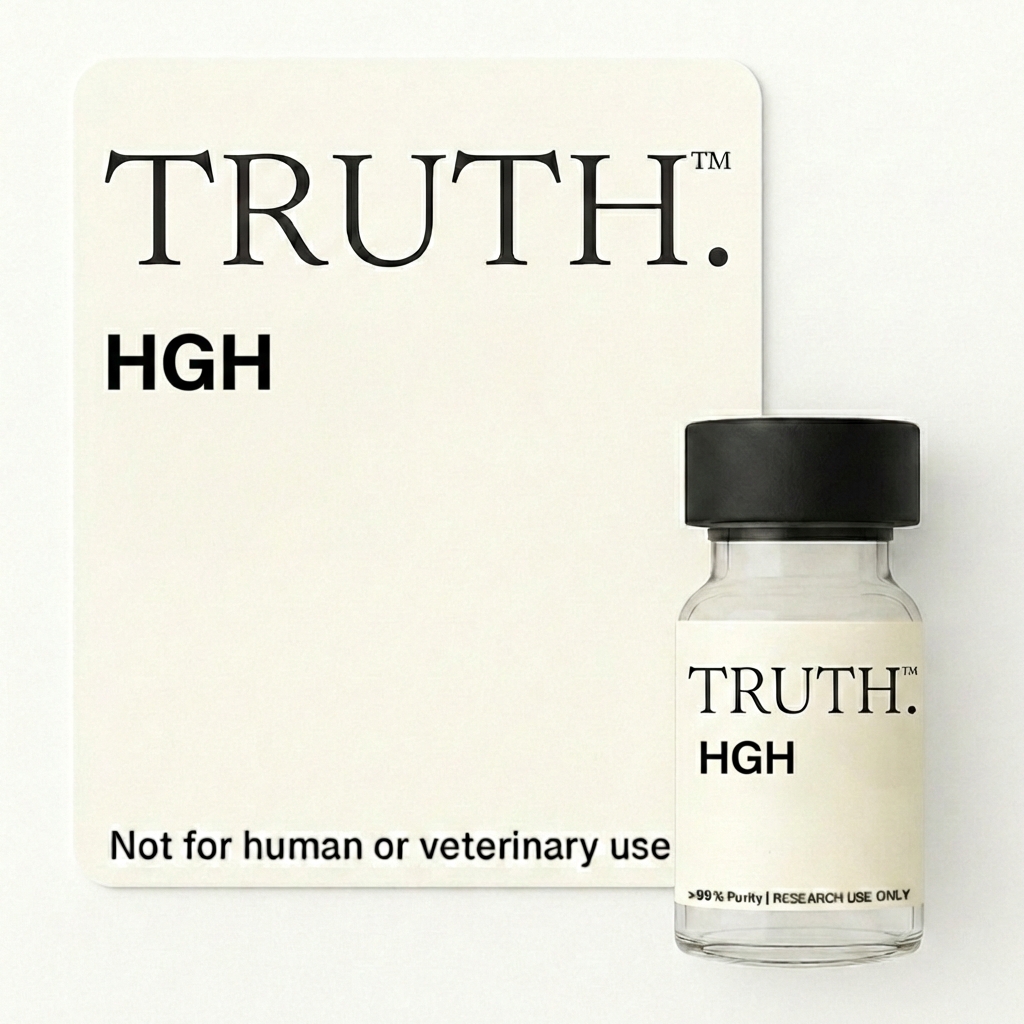
VITAL — Human Growth Hormone
Recombinant Protein for Growth Hormone Pathway Research
🎁 FREE 3ml Bacteriostatic Water with Every Vial Purchased
Every peptide vial order automatically includes a complimentary 3ml vial of bacteriostatic water at no extra cost.
US$51.00 – US$68.00Price range: US$51.00 through US$68.00
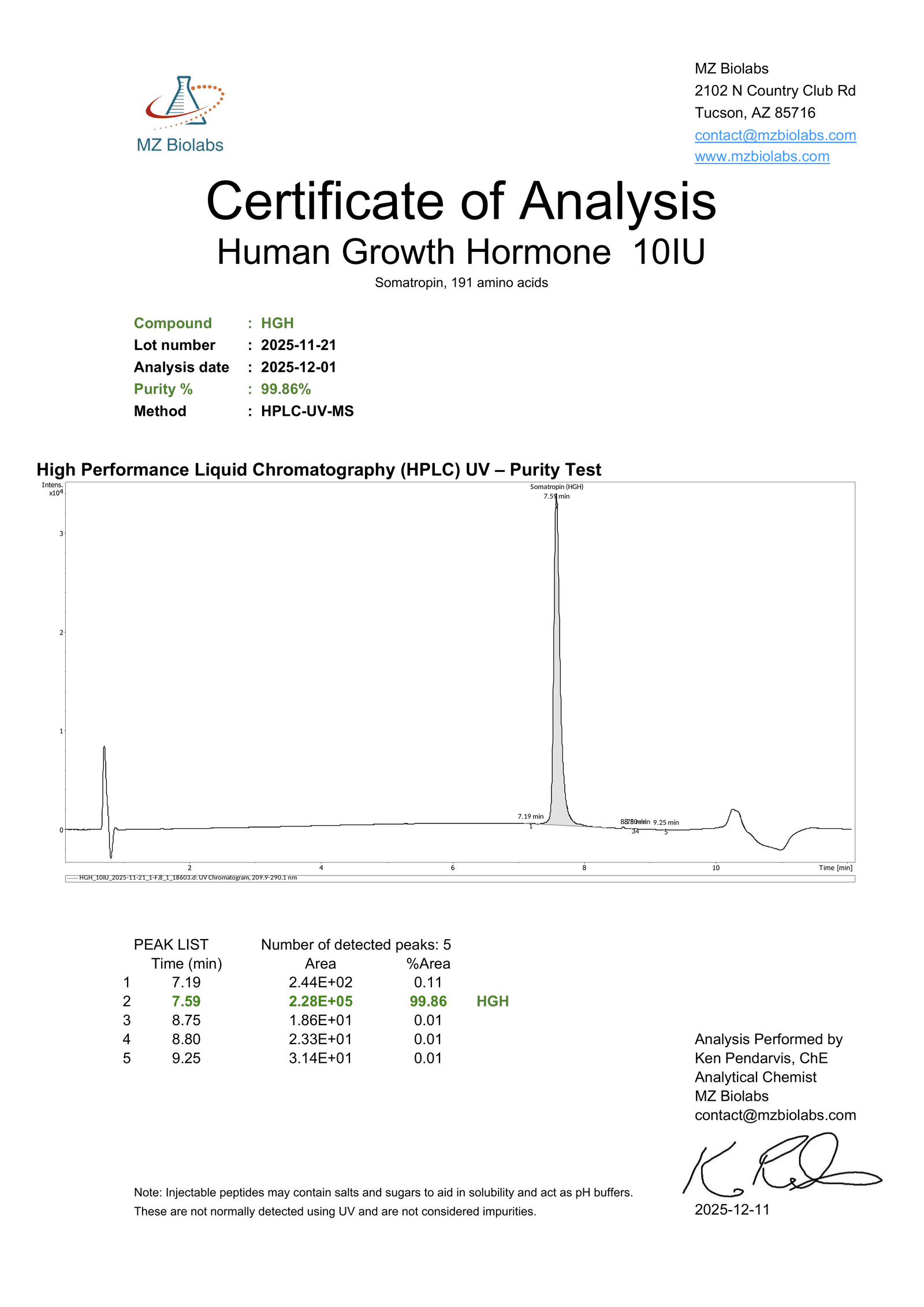
- 99%+ Purity Tested
- Canadian Lab Tested
- Ships from Toronto, Ontario
- Free Bacteriostatic Water with Every Order
Overview
Human Growth Hormone (HGH), also known as somatotropin, is a recombinant protein identical in structure to endogenous human growth hormone. It is extensively studied for its role in growth hormone signaling, metabolic regulation, and systemic anabolic pathways.
In research settings, HGH is examined for its interaction with growth hormone receptors (GHR) and downstream signaling cascades involved in cellular growth, repair, and metabolic coordination.
HGH is frequently referenced in endocrinology, metabolism, aging, and recovery-focused research models due to its central role in physiological growth hormone pathways.
For research only !!
| Weight | 0.01 kg |
|---|---|
| Dimensions | 5 × 2 × 2 cm |
| Strength | 10iu, 15iu |
Mechanism of Action
HGH functions by binding to growth hormone receptors (GHR) located on target tissues, initiating intracellular signaling cascades that regulate growth and metabolism.
Research indicates HGH signaling involves:
- Activation of JAK-STAT signaling pathways
- Regulation of insulin-like growth factor-1 (IGF-1) expression
- Modulation of protein synthesis signaling
- Coordination of lipid and carbohydrate metabolism pathways
Unlike upstream secretagogues, HGH acts as a direct signaling molecule, making it a key reference compound for studying growth hormone receptor dynamics and downstream effects.
Research Applications
Growth Hormone Signaling Research
HGH is widely studied as a primary reference in GH pathway analysis:
- Growth hormone receptor activation
- Signal transduction efficiency
- IGF-1–mediated pathway modeling
- Feedback regulation studies
Metabolic & Energy Regulation Research
Growth hormone plays a central role in metabolism:
- Lipid metabolism signaling
- Glucose homeostasis modeling
- Energy partitioning studies
- Endocrine-metabolic interaction research
Tissue Growth & Repair Research
HGH signaling is closely associated with anabolic pathways:
- Cellular growth signaling markers
- Protein synthesis pathway analysis
- Tissue regeneration models
- Structural maintenance signaling
Aging & Longevity Research
Changes in GH signaling are a focus in aging studies:
- Age-associated GH decline models
- Endocrine aging pathway analysis
- Cellular resilience and repair signaling
- Longevity-related endocrine research
Endocrine System Modeling
As a primary endocrine hormone, HGH is used in:
- Hormonal axis interaction studies
- Pituitary-peripheral signaling research
- Hormone feedback loop modeling
Comparative endocrine pathway analysis
Research Advantages
Why Researchers Study HGH
- Identical to endogenous human growth hormone
- Central regulator of growth and metabolic pathways
- Direct receptor-level signaling model
- Widely referenced benchmark in GH research
- Foundational compound for endocrine studies
HGH is valued as a core reference molecule for understanding growth hormone biology rather than indirect pathway stimulation.
IMPORTANT:
This product is exclusively intended for laboratory research purposes only.
Not approved for human consumption or veterinary use.
Not intended for diagnostic, therapeutic, or consumable applications.
Scientific References
Isaksson OGP, et al. “Growth hormone regulation of growth.” Endocr Rev. 1985.
Veldhuis JD, et al. “Endocrine control of growth hormone secretion.” Physiol Rev. 2001.
Waters MJ. “The growth hormone receptor.” Growth Horm IGF Res. 2016.
Le Roith D, et al. “The somatotropic axis and aging.” Endocr Rev. 2001.
Carter-Su C, et al. “Signaling pathways activated by growth hormone.” Trends Endocrinol Metab. 2016.